
What Size Generator Do I Need? kVA Sizing Guide Malaysia
What Size Generator Do I Need? A kVA Sizing Guide for Malaysian Factories and Buildings
The right generator size is the smallest one that can start your largest motor and carry your full running load, with a margin for growth. Get it wrong and you either pay for capacity you never use, or watch the generator trip the moment a compressor kicks in.
This guide walks through the numbers in plain language: what kW and kVA mean, why power factor matters, how motors change the picture, and how to work out a size for your factory or building. It ends with a quick sizing table you can use for a first estimate before speaking to a supplier.
A note on Malaysian supply: low voltage supply in Malaysia is 230 V single-phase and 400 V three-phase at 50 Hz. Many older sites and equipment still refer to the previous 240/415 V standard. Your generator must match your site’s voltage and frequency, so confirm this before you size.
kW vs kVA: what’s the difference?
kW (kilowatts) is real power: the energy that actually does work, such as turning a motor, heating an element or lighting a lamp. The engine has to produce it, so kW sets how big the engine must be and how much fuel it burns.
kVA (kilovolt-amperes) is apparent power: the total current and voltage the generator must deliver, including the part that does no useful work. The alternator has to carry it, so kVA sets how big the alternator must be.
The gap between the two comes from power factor (PF). Motors, transformers and fluorescent lighting draw extra “reactive” current to build magnetic fields. That current does no work, but it still flows through the generator. A simple way to picture it is a glass of beer: kW is the beer, the reactive part is the foam, and kVA is the whole glass. You pay to fill the whole glass.
Why 0.8 matters: industrial diesel generator sets are normally rated at 0.8 power factor. So a 500 kVA genset delivers 400 kW of real power. If your load has a lower power factor, say 0.7, the alternator reaches its kVA limit before the engine reaches its kW limit.
Generator rating | Real power at 0.8 PF |
100 kVA | 80 kW |
250 kVA | 200 kW |
500 kVA | 400 kW |
1,000 kVA | 800 kW |
2,000 kVA | 1,600 kW |
For reference, TNB requires customers below 132 kV to keep their load power factor at 0.85 or higher. Most factories already have power factor correction for this, but capacitor banks can behave badly on generator supply, so ask your electrical engineer how they will be switched during an outage.
Motor starting loads: the hidden sizing factor
In most factories, the generator is sized by the biggest motor start, not the running load. An induction motor started direct-on-line can draw 6–8 times its full-load current for a few seconds while it gets up to speed, and at a very low power factor.
On the grid, TNB’s network absorbs that surge easily. A generator cannot. A large start pulls the voltage and frequency down, which can make lights flicker, drop out contactors on other machines, or stall the motor itself. Most designs aim to keep the voltage dip during a start within 15–20%.
The starting method makes a large difference to the generator size you need:
Starting method | Starting current (× full-load current) | Rule of thumb for generator size |
Direct-on-line (DOL) | 6–8× | About 2–3× the motor’s kW rating, in kVA |
Star-delta | 2–3× | About 1.5× the motor kW; watch for a second surge at changeover |
Soft starter | 2–4× (adjustable) | About 1.2–1.5× the motor kW |
Variable speed drive (VFD) | About 1–1.2× | About 1.2× the motor kW, plus an allowance for harmonics |
These are first-estimate rules of thumb. Final sizing should use the motor’s nameplate data and the generator manufacturer’s motor-starting curves.
Three practical ways to cut generator size:
- Start the largest motor first, when the generator has no other load.
- Stagger starts with timers or the PLC, so motors come on one at a time, a few seconds apart.
- Fit soft starters or VFDs to large motors such as compressors, chillers and pumps. The saving in generator size often pays for the starter.
How to size a generator: step by step
- Decide what must run on backup. The whole site, or only critical loads such as production lines, cold rooms, IT and safety systems? This is the biggest single decision.
- List each load and its running kW. Use nameplates, the single-line diagram, or your TNB bill’s maximum demand as a cross-check.
- Add up the running load and convert to kVA. Divide total kW by 0.8 (or your measured power factor if it is lower).
- Check the largest motor start. Using the table above, work out its starting kVA and add it to the load already running when it starts.
- Take the higher of steps 3 and 4.
- Add a growth margin of 20–25% for new machines and expansion.
- Round up to the next standard generator size.
Worked example: a 300 kW factory in Penang
A metal-fabrication factory wants its whole site on backup power. Its loads are:
Load | Running kW | Notes |
Production machines | 120 | Mixed small motors |
Air compressor | 75 | Largest motor, star-delta start |
Chillers and AHUs | 60 | |
Lighting | 25 | LED |
Office and IT | 20 | Includes server room UPS |
Total | 300 |
Running load: 300 kW ÷ 0.8 = 375 kVA.
Compressor start: the 75 kW compressor runs at about 94 kVA. Star-delta starting draws roughly 2.5 times that, so about 235 kVA during the start.
- If the compressor starts last, the other loads (225 kW, about 281 kVA) are already running. Peak demand is 281 + 235 = about 516 kVA.
- If the compressor starts first, the peak during its start is only about 235 kVA, and the sizing case becomes the running load of 375 kVA.
With a 25% growth margin:
Start sequence | Sizing case | With 25% margin | Generator to choose |
Compressor starts last | 516 kVA | 645 kVA | 650–750 kVA |
Compressor starts first | 375 kVA | 469 kVA | 500 kVA |
Simply programming the start sequence saves one or two generator sizes. That means a lower purchase price, a smaller footprint and better fuel efficiency, because the generator runs closer to its rated load.
Quick generator sizing table
Use this table for a first estimate only. Real requirements vary widely with how much of the site is on backup, the equipment installed and how motors are started.
Premises type | Typical generator size | Common configuration |
Telecom site or small kiosk | 15–30 kVA | Canopy |
Shophouse, small office or clinic | 20–100 kVA | Canopy |
Restaurant, F&B outlet or petrol station | 30–100 kVA | Canopy |
Construction site (temporary power) | 50–500 kVA | Canopy or truck-mounted |
SME factory or workshop | 100–500 kVA | Canopy or open |
Office building (essential loads) | 300–800 kVA | Open in plant room, or canopy |
Hotel | 500–1,500 kVA | Open or canopy |
Medium factory (E&E, plastics, food processing) | 500–2,000 kVA | Open or containerised |
Hospital | 500–3,000+ kVA | Open or containerised, N+1 |
Shopping mall | 1,000–4,000+ kVA | Open, multiple sets in parallel |
Large plant or data centre | 2,000 kVA+ per set, multiple sets | Containerised, paralleled |
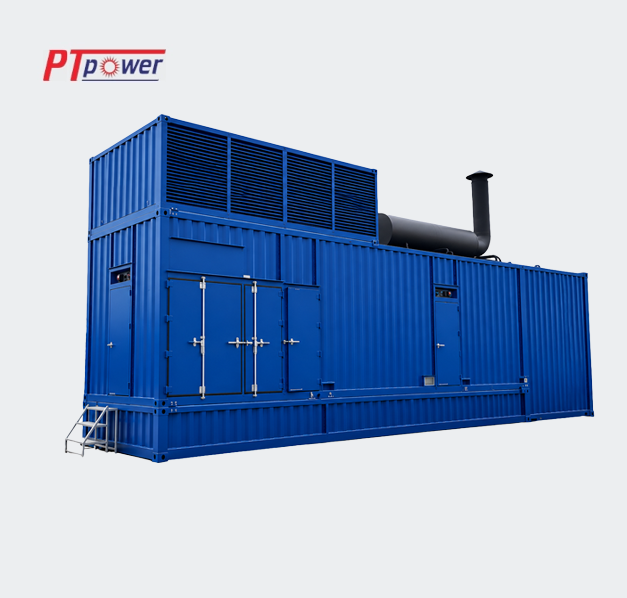
HSP Power Systems supplies open type sets from 15 kVA to 4,125 kVA, canopy sets from 15 kVA to 750 kVA, containerised sets from 750 kVA to 4,125 kVA, and truck-mounted gensets for temporary power.
Other factors that change the size
Standby, prime or continuous rating. The same generator carries a different rating depending on how it is used. A standby rating applies to backup use during outages. A prime rating applies when the generator is the main power source for unlimited hours at varying load, and is lower than the standby figure. A continuous rating applies to constant base load and is lower still. If your site runs on the generator for long periods, size on the prime rating.
Harmonics from non-linear loads. VFDs, UPS systems, rectifiers and LED drivers distort the current waveform. This heats the alternator and can upset the voltage regulator. Sites with a high share of these loads often need an oversized alternator, even if the engine is the right size.
Heat and ventilation. Malaysia’s hot, humid climate and poorly ventilated plant rooms reduce generator output. Generators are rated at standard reference conditions, so check the manufacturer’s derating if the room or enclosure will run hot.
Light loading. Running a diesel generator far below its rating for long periods causes wet stacking, where unburnt fuel and carbon build up in the exhaust. Oversizing “to be safe” makes this worse. Aim for the generator to run at roughly 50–80% of its rating in normal use.
One large set or several smaller ones. Two or more sets in parallel give redundancy, let you run only what the load needs, and allow one set to be serviced while the other runs. For large or critical sites, this often beats a single big unit.
Common sizing mistakes
- Treating kVA and kW as the same. A 500 kVA set is not a 500 kW set. At 0.8 power factor it delivers 400 kW.
- Ignoring motor starts. Sizing only on running load is the most common reason a new generator trips on day one.
- Copying the TNB transformer size. Your utility supply is often sized well above your real demand. Use measured maximum demand or a proper load list instead.
- Oversizing “just in case”. It costs more to buy, burns more fuel per kWh and leads to wet stacking.
- Forgetting future expansion. The opposite problem: no margin means replacing the set when you add one more production line.
- Choosing on price per kVA alone. Check the engine and alternator brands, the standby vs prime rating quoted, and local service and spare parts support.
Get a generator sized for your site
Since 1988, HSP Power Systems has supplied diesel generator sets to factories, commercial buildings, hospitals and data centres across Malaysia. Our team can review your load list, motor starting methods and site conditions, then recommend the right size and configuration, from 15 kVA to 4,125 kVA.
Not sure where to start? Speak to our power specialists with your TNB bill or a list of the equipment you need to keep running, and we will help you work out the numbers.
Frequently asked questions
How do I convert kW to kVA for a generator?
Divide kW by the power factor. For a standard 0.8 power factor, kVA = kW ÷ 0.8. So 400 kW needs a 500 kVA generator.
Can I use my TNB bill to size a generator?
Yes, as a starting point. The maximum demand on your bill shows your actual peak load. Add motor starting and a growth margin on top of it.
What size generator do I need for a 100 kW load?
At 0.8 power factor, 100 kW is 125 kVA. With a 20–25% margin, a 150–160 kVA set is a typical choice, but check for large motor starts first.
Is it bad to oversize a generator?
Moderate margin is good. Heavy oversizing raises cost and causes wet stacking, because diesel engines run poorly at light load for long periods.
What is the difference between standby and prime rating?
Standby is for backup use during outages. Prime is for when the generator is the main power source and runs for long hours. The prime rating is lower than the standby rating for the same set.
Do I need a three-phase generator?
Most factories and commercial buildings in Malaysia use three-phase 400 V supply, so they need a three-phase generator. Small premises on single-phase 230 V supply can use a single-phase set.
Recent Post

Our Products
Power Solutions
Spare Parts & Accessories